My Job Searching Journey in Web 3

This post is adapted from a talk I gave at the DHK sharing session on May 16, 2026 — DHK Drifting Classroom — about my experience looking for a job in the Web3 industry.
A Quick Intro: About Me
For the past few years, I've been deep inside the blockchain world. I spent four years as a Developer Relations Engineer in the Polkadot ecosystem, and then spent a little over a year shifting my focus to Ethereum.
In that year-plus, I did a few things that meant a lot to me personally:
- Went deep on privacy tech — particularly the fundamentals of zk-SNARKs and FHE (fully homomorphic encryption).
- Completed both PSE Bootcamp 2024 and the Rareskills ZK Bootcamp end to end.
- Received a grant from the Ethereum Foundation from December 2024 to February 2025 to develop the Semaphore MultiSig Smart Account Module. It was also mentioned in the official EF blog.
- Built an on-chain encrypted voting app using Zama's fhEVM, which won 2nd place in a Zama FHE season bounty (April 2025).
- Was selected for the Ethereum Protocol Fellowship Cohort 6 (August to November 2025), and presented at Devconnect 2025.
Since June 2025, I've been on a job search mode. As of today, two companies have advanced me to the final stage — one of them took me through four rounds of interviews.
If you want a fuller picture of my background, feel free to check out my GitHub profile and LinkedIn profile.
What follows are the lessons I've picked up along the way about building a career in Web3 development. I hope they're useful to anyone trying to break into the field, or anyone looking to go further down this road.
Five Roles for a Web3 Developer
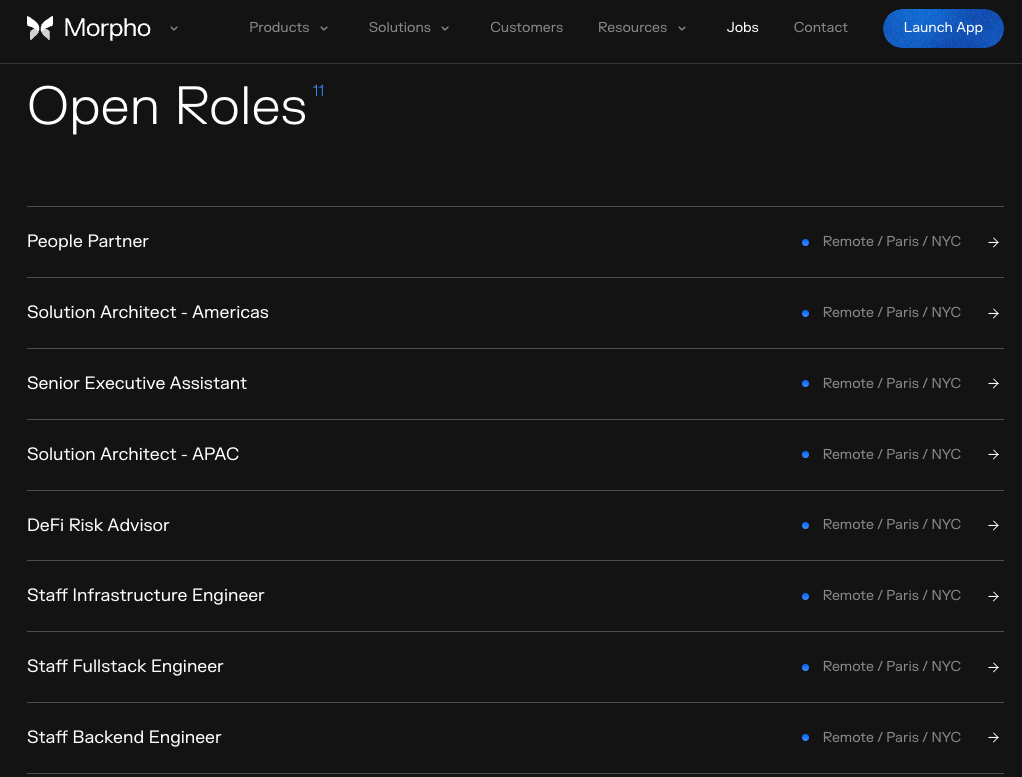
When people hear "Web3 developer," many of them only picture one thing: writing smart contracts. In reality, the role spectrum in this industry is much wider than most people think. Open Morpho's careers page, or look at LayerZero or Chainlink's openings, and you'll find that engineering roles fall into at least five distinct categories.
1. Smart Contract Engineer
This is the role everyone's most familiar with. On the EVM side, it's basically Solidity, with Foundry and Hardhat as the main tools. On the Solana side, it's Rust.
But what this role really tests isn't "can you write smart contracts" — it's "do you know how to hack smart contracts." In interviews, companies will typically hand you a contract and ask you, on the spot, to find the vulnerabilities, explain how you'd exploit them, and then explain how you'd fix them. An attacker's instinct matters more than the ability to type Solidity.
The smart contract world breaks down into several sub-domains:
- DeFi: swaps (Uniswap), lending and yield-bearing tokens (Aave, ERC-4626)
- Account Abstraction: ERC-4337, ERC-7702, ERC-7579
- Cross-chain: LayerZero, Chainlink
- Oracles: Chainlink
- Privacy Tech: zero-knowledge proofs, or FHE on-chain (e.g. Zama's fhEVM)
Some learning resources I lean on:
- EVM courses: Cyfrin Updraft is solid. The Advanced Foundry Course and Smart Contract Security modules are especially practical, and there's also a full-stack web3 development track.
- Rareskills: their blog and books are genuinely substantive, and the Zero Knowledge book is one of the most thorough ZK introductions I've come across.
- Hands-on practice: CodeHawks and Code4rena are competitive platforms for both hacking and securing smart contracts.
I'm currently working through Atrium's Uniswap Hook Incubator myself — learning by building.
2. Protocol / Backend Engineer
This is the role that writes the low-level code for Ethereum nodes, Solana nodes, and other client implementations. The language is usually Rust or Go.
The best thing about this track: the entire ecosystem is open source. You don't have to wait for a company to onboard you — you can start contributing today.
A few codebases and resources worth following:
- Lighthouse (Ethereum consensus client): website / GitHub
- Reth (Ethereum execution client written in Rust)
- Geth (Ethereum execution client written in Go): website / GitHub
- Lean Ethereum Roadmap
More importantly, this community runs regular, fully public dev calls. You can drop into them, listen to the discussion, and start understanding where the protocols are heading:
My recommendation: before you apply for these roles, land 3 to 5 substantive Pull Requests in one of these repos. Join their Discord, get embedded in the developer circle. Once you're someone they recognize by name, your résumé carries a completely different weight.
This is the highest bar of the five roles, but it also pays the best.
3. DevOps / Infrastructure Engineer
This role takes care of blockchain node operations. The toolchain typically looks like:
- Docker, Kubernetes, shell scripting
- Python
- Log monitoring, system health, observability (the canonical stack here is Prometheus + Grafana dashboards)
For engineers coming from traditional DevOps or cloud DevOps backgrounds, this is the most natural entry path into Web3.
4. Developer Relations Engineer (DevRel)
DevRel's essence is being the bridge between the protocol/core product and the developer community. The day-to-day usually splits into three buckets:
- Writing code and quick-start guides: building demos, writing examples, tying the docs together, and showing developers how to use the platform's APIs to ship what they need quickly.
- Producing technical content: documentation, technical articles, tutorial videos. I think Lee Robinson's Cursor tutorial series is a great example of what DevRel content can be — substantive, and still genuinely fun to read.
- Running events and speaking on stage: online workshops, in-person developer meetups, and giving talks at developer conferences. (Worth keeping an eye on the upcoming Ethereum Devcon 8 India and Synthesis Hackathon — browsing the winning projects alone is a free education.)
5. Solution Architect / Forward Deployed Engineer
This role is the bridge between the protocol/core product and enterprise clients. You'll see it most often around enterprise-facing products — including the DeFi platforms that are now converging with TradFi and RWA.
The skill set overlaps significantly with DevRel, but it leans more heavily on understanding the client's business and getting the product to actually run inside the client's tech stack.
Engineer Levels and Compensation
Engineering ladders at international companies generally come in four tiers:
| Level | Experience | Annual Salary (Outside North America) |
|---|---|---|
| Engineer | 0 – 3 years | — |
| Senior Engineer | 3 – 5 years | US$120k – 160k |
| Staff Engineer | 5 – 8 years | US$160k – 240k |
| Principal Engineer | 8+ years | US$240k or higher |
If you're based in North America (especially NY or CA), the same level usually adds roughly US$40k/year on top.
There's a reality to face: (Junior) Engineer positions barely exist anymore. AI has eaten a lot of the 0–3 year work, and most teams now start hiring at the Senior Engineer level.
If you honestly assess yourself and feel you're not yet at Senior level, the focus right now should be on upskilling — but you can still send out résumés periodically just to get a read on the market:
- Learn: take bootcamps, training programs, and online courses.
- Practice: enter hackathons, take on bounties.
- Show up: if a company you want to work at runs public dev calls or dev meetups, go to them.
- Embed in the community: if you're interested in Ethereum or Solana, just join their developer community calls. These calls are open to anyone — nobody's going to ask which company you work for.
Three Markets: Overseas, Hong Kong, Singapore
Overseas Companies (US, Europe)
- About half of the openings come with location restrictions — many explicitly require NYC or CA.
- Even when remote is allowed, there's usually a time zone constraint (roughly UTC −7 to +3, covering North America, South America, and as far east as Central Europe). These jobs typically require you to be comfortable with 10pm–12am meetings if joining from APAC.
- The roles most realistically available for Asia are Solution Architect or DevRel – APAC. Unless your engineering chops are exceptional, breaking into a core dev team from this side of the world is hard.
- A small slice of opportunities also exists in Australia, which sits around UTC +11.
Hong Kong
- Most of the market is centralized exchanges (CEXs): Bullish, HashKey, OKX, Futu, Animoca Brands (NFT), and so on.
- The work is overwhelmingly tied to DeFi and trading. Very few companies here are working on lower-level protocols.
- Worth noting: many blockchain companies in Hong Kong have some footprint of mainland giants like Tencent, Alibaba, or OKX behind them.
Singapore
- Noticeably more blockchain companies than Hong Kong. From feel alone, the supply ratio is roughly 3 : 7 between Hong Kong and Singapore.
Few Other Things to Pay Attention
A handful of smaller — but no less important — reminders:
- Polish your LinkedIn and GitHub profiles. These are the first thing recruiters see, and sometimes the reason they reach out to you in the first place.
- Watch out for phishing recruiters. There are plenty of scammers posing as recruiters who'll send you a "source code" and ask you to run it and discuss changes. The moment you run that program, the data on your machine gets shipped out. Any interview flow that asks you to run unknown programs should be treated as a red flag.
- Genuinely integrate AI into your engineering workflow. AI-assisted coding and agentic coding (Cursor, Claude Code, etc.) are likely a paradigm shift in software development. You either work with AI, or you get replaced by someone who does.
- Now that you're in this industry, protect your crypto assets. You don't know when you'll become someone's target:
- Invest in a decent hardware wallet — usually under US$300.
- Use a Safe multi-sig for any long-term holdings.
Closing Thoughts
Web3 is still an industry in fast motion. The tech stack changes every year, valuations swing wildly, but demand for engineers who can actually ship has never gone away.
What this past year of transition taught me is this: the most valuable thing in this industry is the trail you leave in public — your GitHub commits, the PRs you've sent, the questions and contributions you've shared in dev calls, the bounties you've completed, the articles you've written. Get enough of that out there, and jobs start finding you.
I hope this is helpful, wherever you are on the road. Wishing you the best of luck.